
In a world changing faster than most education systems can keep up with, one question matters more than ever: are we truly preparing young people for the future?
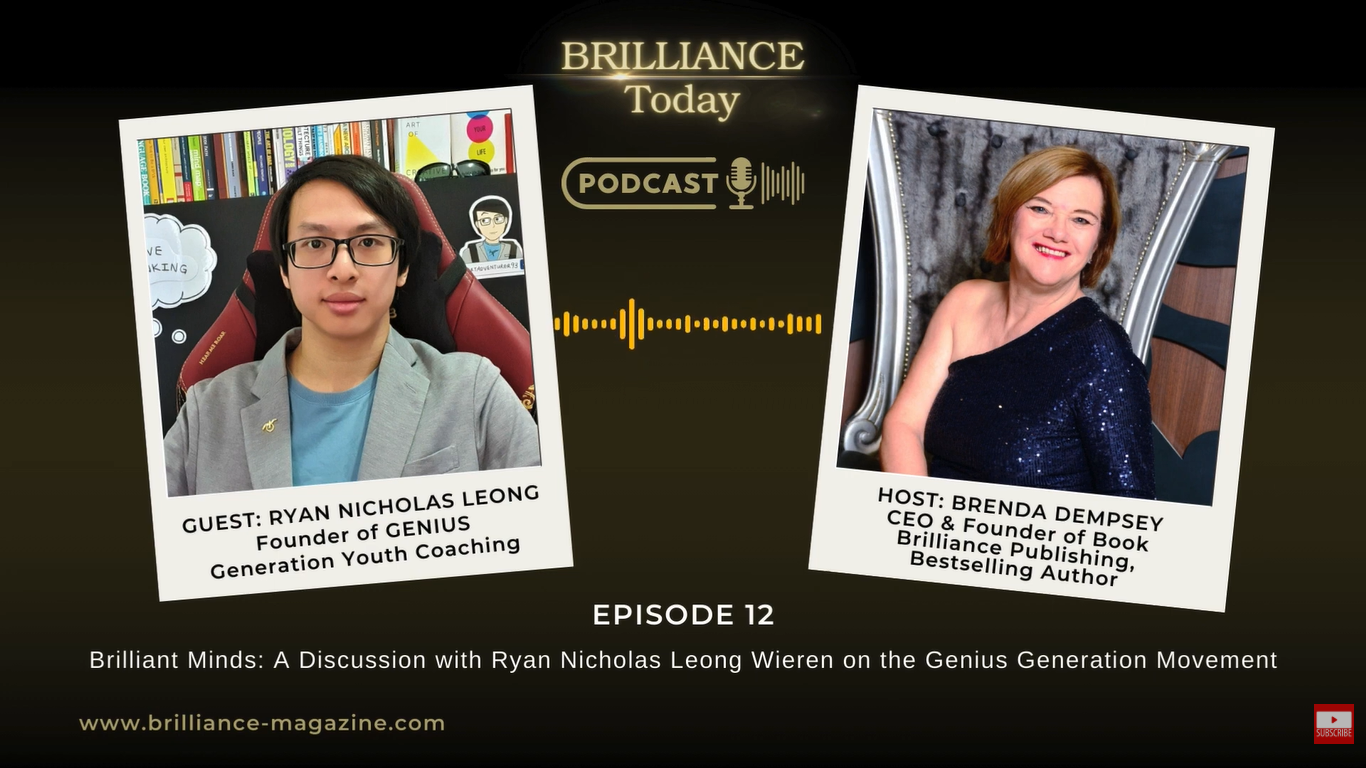
In this inspiring episode of Brilliance Today, host Brenda Dempsey speaks with Ryan Nicholas Leong Wieren, the first Genius Generation Youth Coach in Singapore, and perhaps the world. Their conversation is a powerful exploration of what education could become when it moves beyond grades, standardization, and outdated systems, and begins to focus on the whole person.
Ryan’s message is both simple and transformative: it is time to ignite the genius within every young person.
Why the Current Education System Needs to Evolve
Ryan’s work began with a clear observation: traditional education often places young people into boxes rather than helping them discover who they truly are. While the world faces increasingly complex challenges, from climate change and war to rapid technological disruption, many schools still teach in ways that have changed little over centuries.
This mismatch is becoming impossible to ignore.
According to Ryan, the issue is not just academic performance. The deeper problem is that many students are not being taught in ways that are natural to them. They are rarely shown how they learn best, how they process information, or how their interests can become gateways to deeper engagement and success.
Instead of drawing out individuality, much of education still rewards conformity.
Ryan believes that if we want to solve today’s global problems, we must first elevate human consciousness. That begins with transforming education at its roots.
A Personal Story That Fueled a Purpose
Ryan’s mission is deeply personal.
At just 12 years old, he survived childhood cancer, an experience that changed the way he saw life. Facing mortality so young gave him an acute awareness of how fragile life is and how precious time can be. Rather than allowing that experience to harden him, he used it as a catalyst to live with greater urgency and purpose.
He also shared the pain of losing a friend at a young age, another life-changing moment that reinforced his belief that every moment matters.
These experiences shaped Ryan’s commitment to helping others. He understands that success is not only about academic results or career milestones. It is also about emotional intelligence, self-awareness, meaningful relationships, and the courage to grow through adversity.
His story reminds us that some of the most powerful leaders are those who choose to turn pain into purpose.
Education Must Be Holistic, Not Fragmented
One of the strongest themes in the conversation is the need for a more holistic approach to learning.
Ryan openly reflected on his own earlier mistakes, including focusing too heavily on academic achievement while neglecting emotional intelligence. That imbalance led to personal struggles and difficult relationships. Through those experiences, he realized that true development must be holistic.
A young person may earn excellent grades, but if they cannot handle setbacks, communicate well, adapt to change, or regulate their emotions, they are not fully prepared for life.
This is where Ryan’s vision stands out. He is not simply advocating for better academic outcomes. He is calling for a broader and more human model of education, one that develops mind, heart, and character together.
What It Means to Live and Learn in Flow
Ryan also spoke about his work as a flow consultant, drawing inspiration from Roger James Hamilton’s framework.
Flow is that deeply engaged state in which a person is fully immersed in what they are doing. In this state, work feels meaningful, learning becomes energizing, and creativity flourishes. Rather than being distracted by fear or external pressure, a person is fully present and performing at their best.
For Ryan, creating flow in learning is essential. That might involve music, relevant interests, engaging methods, or aligning learning with a student’s natural strengths. When young people are supported in ways that help them enter this state, learning stops feeling like obligation and starts becoming a source of momentum.
And when someone works from flow, others can feel it. There is a difference between going through the motions and creating something with heart and soul.
From Resilience to Anti-Fragility
One of the most memorable ideas from the episode is Ryan’s use of the term anti-fragile.
Many people talk about resilience as the ability to bounce back. Ryan goes a step further. Anti-fragility is not just about surviving difficulty. It is about becoming stronger because of it.
In a fast-changing world, simply enduring disruption is not enough. Young people need to learn how to respond to uncertainty by adapting, growing, and rising to a higher level than before.
Ryan used AI as a modern example. When tools like ChatGPT entered education, many reacted with fear, worrying about job loss, cheating, and uncertainty. But Ryan’s perspective is different. Rather than resisting innovation, we should ask how to learn from it and integrate it in ways that empower us.
That is anti-fragility in action: not waiting for the storm to pass, but learning how to use the wind to move forward.
The Five Pillars of Genius Generation Youth Coaching
At the heart of Ryan’s work is a five-part framework designed to complement what students learn in school and fill the gaps traditional systems often leave behind.
- Learning How You Learn
Every child learns differently. Before anything else, Ryan believes young people need to understand their own learning style, strengths, and ways of processing information. This self-awareness becomes the foundation for confidence and growth.
- Developing Essential Life Skills
Academic knowledge alone is not enough. Students need practical skills for real life, such as navigating tension, building adaptability, and responding effectively in common but challenging situations. These are the tools that help people thrive beyond the classroom.
- Learning from Exemplary Role Models
Ryan encourages learning not only from historical figures but also from fictional characters and stories that resonate with young people. Whether through history, literature, or even anime, role models can teach courage, creativity, discipline, and perseverance.
- Entrepreneurship Education
Rather than preparing young people only to find jobs, Ryan wants them to know they can create opportunities too. Entrepreneurship teaches initiative, problem-solving, and ownership, qualities that are invaluable in a rapidly changing economy.
- Creative Thinking and Collaboration
The future belongs to those who can imagine new possibilities and work with others to bring them to life. Ryan emphasizes creative thinking as a survival skill for the new economy, especially in a world where tomorrow’s challenges may look very different from today’s.
Together, these five pillars form a vision of education that is dynamic, practical, and deeply empowering.
A Global Vision for the Future of Learning
Ryan’s ambitions stretch far beyond local impact.
He shared his desire to bring this model of education to a global stage through digital platforms, micro-degrees, and translated content that can reach people across cultures. He also hopes to collaborate with schools in Singapore and explore how AI and the metaverse could expand access for underprivileged and disabled learners.
This is a bold and timely vision.
Technology, when used with purpose, can become a bridge rather than a barrier. It can democratize learning, increase access, and help bring life-changing ideas to those who might otherwise be excluded from them.
Ryan is not just imagining a better education system. He is actively building pathways toward it.
A Final Call: Ignite Your Genius
When Brenda asked Ryan to share three words of wisdom, his answer captured the essence of the entire conversation:
Ignite your genius.
It is more than a slogan. It is an invitation.
An invitation to stop shrinking into systems that do not fit.
An invitation to grow through adversity instead of being defined by it.
An invitation to learn, adapt, create, and contribute with purpose.
Ryan Nicholas Leong Wieren’s message is clear: genius is not reserved for a gifted few. It lives within each of us, waiting to be recognized, developed, and expressed.
The future of education does not begin with institutions. It begins with a mindset shift.
And perhaps that shift starts with one decision: to believe that brilliance can be cultivated, that learning can be liberating, and that every young person deserves the chance to become fully alive to their potential.
Ignite your genius. The future needs it.