

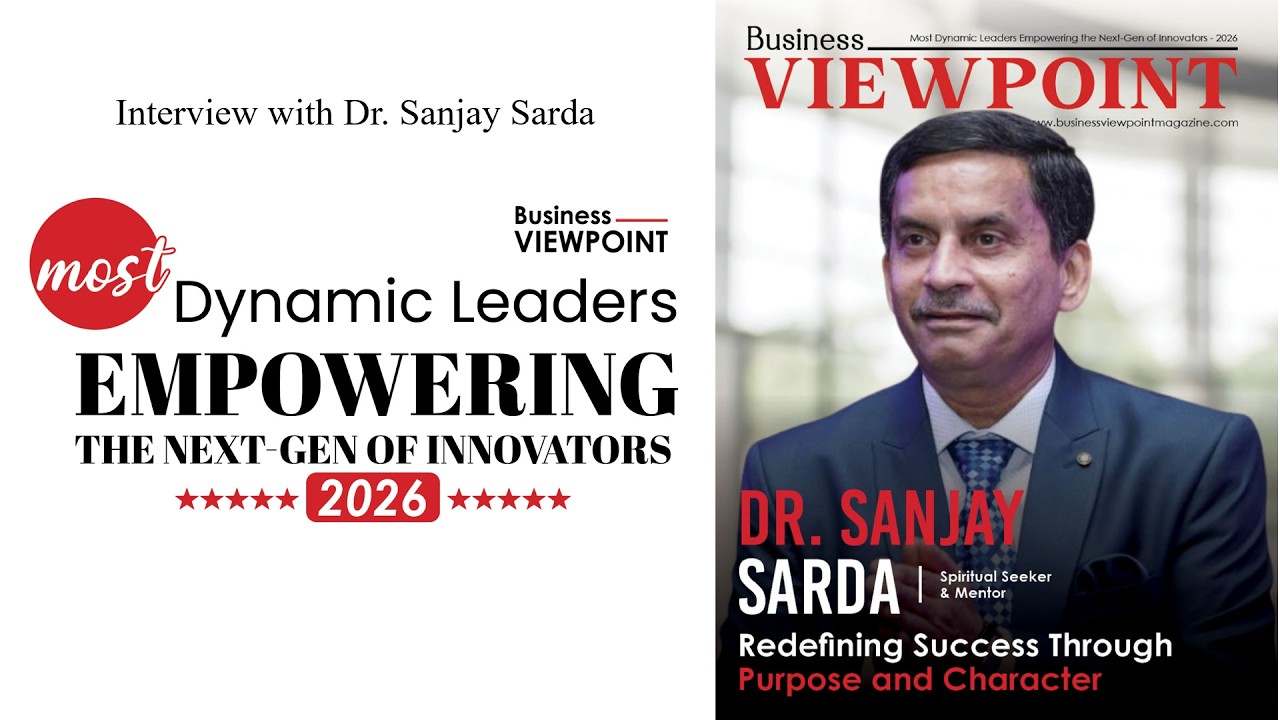
Business Viewpoint Magazine put Dr Sanjay Sarda on the cover of its Most Dynamic Leaders Empowering the Next-Gen of Innovators – 2026 edition. In a conversation with the magazine, he reflects on three decades of corporate leadership, the reinventions that followed, and what separates the founders who last from those who don’t.
Most careers are planned. Dr Sanjay Sarda’s has been discovered, one stage at a time. After nearly three decades in senior corporate leadership, he now works as a mentor, music therapist, lifestyle coach and startup ecosystem leader. His work has been featured in Forbes India, The Times of India, The Economic Times and Hindustan Times. It has earned him the Pride of India Award and recognition from the United Nations Global Peace Council. Yet he is clear that none of it followed a strategy. “It is not a pre-planned journey of transformation,” he says. “It is just evolving.”
Finding the gift, then giving it away
His compass is a line often attributed to Pablo Picasso: the meaning of life is to find your gift, and the purpose of life is to give it away. Most of us, he says, carry talents that stay untapped, held back by the fear of mistakes and of what people will say. His rule for moving past that fear is simple. When a decision is irreversible, use your head. When it can be reversed, follow your heart.
In corporate life he held to one principle: his need for the organisation should always be smaller than its need for him. That meant continually adding skills. When he sensed a plateau, he turned to music. He learned the santoor in the Hindustani classical tradition, opened music academies and took up several more instruments.
Music opened the door to spirituality. He began explaining the logic behind the Bhagwad Geeta, Ramayan, the Mahabharat and the Vedic texts on YouTube, for a younger, English-speaking audience that wants reasons rather than ritual. His work in Music Therapy with cancer patients earned him a doctorate. He was involved in the startup ecosystem, where he served as director of an incubator-accelerator. Even his recent move to Solan, in Himachal Pradesh, was no more planned than the rest.
“Life is all about making mistakes,” he says, “and death is wishing you had made some more.”
Impact over recognition
Asked which honours mean the most, he answers plainly: none of them excite him. What matters is making a difference to one person at a time. That might be a founder in a hard stretch, someone living with insomnia or depression, or a family through a long course of chemotherapy. “If I can add something to someone’s life,” he says, “I will be the happiest.”
Character as a leadership discipline
His core values are integrity and honesty, and he holds that the means matter at least as much as the ends. Drawing on the Gita, he believes in giving our best effort and letting results follow. He sees each of us as a co-creator of our destiny through the choices we make now.
For leaders of innovation teams, he names one essential skill: building synergy, so that the team achieves more than the sum of its members. Over his career he has watched workplace relationships grow more transactional. He urges leaders to make them transformational, so that everyone gives their best rather than the minimum they are paid for.
Updating the inner software
The idea at the heart of the interview comes from more than a hundred startups he has seen up close. Technology, he argues, is only a tool, and it is rarely what fails. “The tech was not the problem,” he says. “The humans behind the tech forgot to update their own internal software.”
In his view, today’s founders can build scalable, commercially viable products better than his generation ever could. Where they fall short is emotional and spiritual intelligence. The challenges are near universal: market shifts, pivots, team breakdowns, funding and governance. What separates those who come through is resilience, determination and a long-term view. It is a marathon, not a 100-metre race, and the quality that carries a founder through it, in a word, is character.
The innovation code
That thinking shapes his framework of six innovator personalities, drawn from the founders he has worked with:
- Rocket Ravi: high on energy and passion, low on focus, always onto the next idea.
- Hustle Harish: mistakes overwork and burnout for the road to success.
- Spreadsheet Sneha: so deep in detail that the core problem slips out of view.
- Zen Zoya: so cool and composed that critical issues are left to drift.
- Family-Business Farhan: treats innovation as a part-time stop-gap, backed by family money.
- Manipulative Monty: all charm, with no content or intent; he may even raise funds, but ends up losing his reputation.
The point, he stresses, is not to label anyone. Every innovator carries all six, with one or two traits dominant. Each trait has strengths and weaknesses, and the code is to leverage the strengths and balance the weaknesses. He remains open to a seventh type, should anyone prove they fit none of the six.
Health, relationships, career
Success, however one defines it, rests on balancing three areas: health, relationships and career. Physical health is the easier part. Mental, emotional and spiritual health are where people struggle, and where music and spirituality help. Relationships need to be harmonious, even if that means letting some go. When health and relationships are in order, time opens up for creativity and self-discovery. That, he says, is his answer to people who ask how he finds time for so much.
Looking ahead
He sees AI arriving in a big way, and treats today’s anxieties about it as the early friction any major change brings. His hope is that the next generation of innovators will pair that capability with emotional and spiritual intelligence. That, he believes, is how they will build businesses that are mature, commercially viable and economically sustainable.
This article draws on Dr Sanjay Sarda’s interview with Business Viewpoint Magazine. Watch the full conversation https://www.youtube.com/watch?v=hTM1igI5mIo and read the cover feature [link to businessviewpointmagazine.com/dr-sanjay-sarda-spiritual-seeker/].